
How to use AI to reduce mental load without giving up agency
The difference between something that carries your open loops and something that becomes another one
David Daniel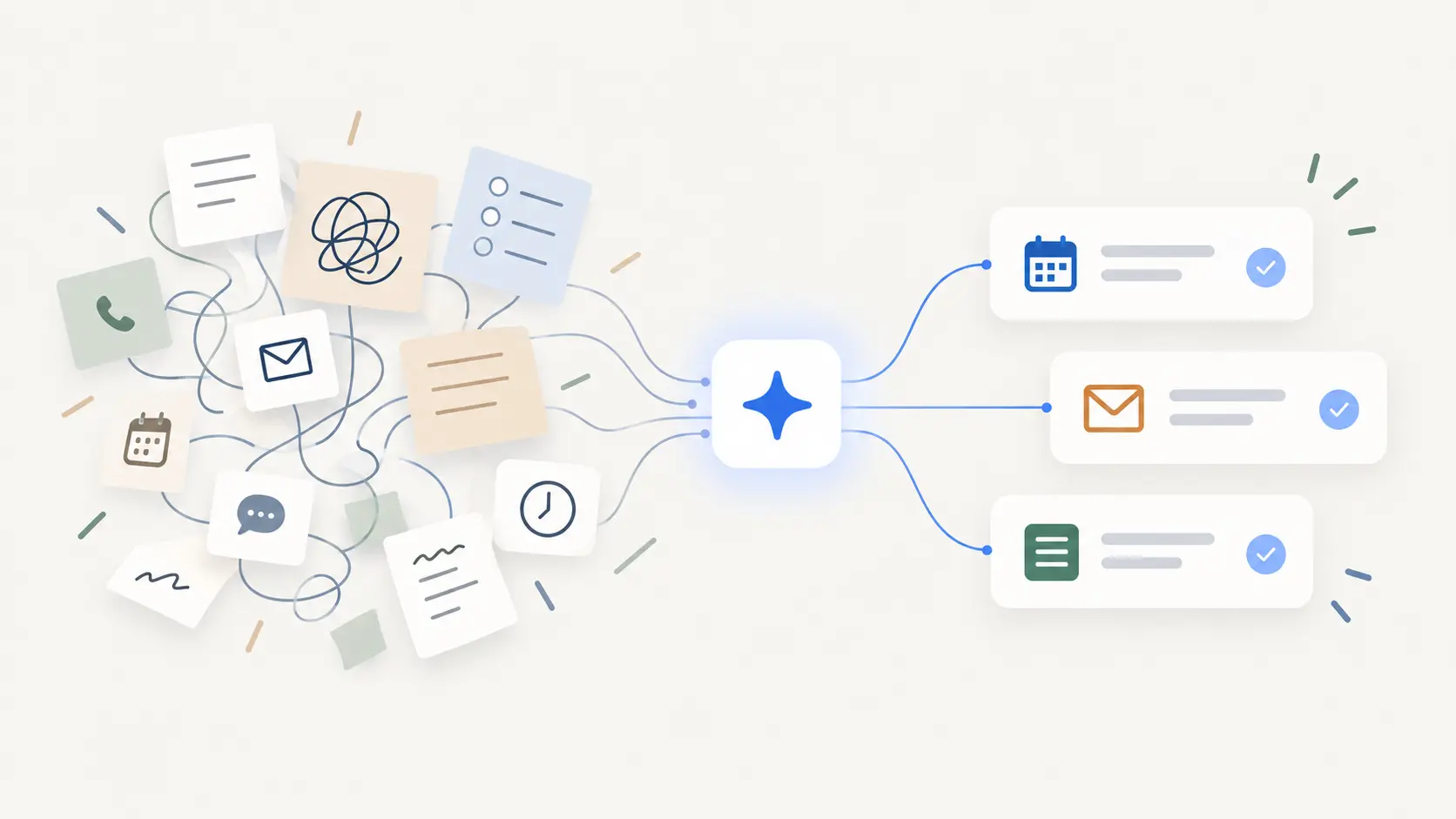
Mental load is the stuff you are holding rather than the stuff you are doing. Knowing the prescription needs renewing. Remembering that someone is waiting on you. Keeping track of the thing that will become urgent in two weeks.
It is invisible, it is not on any list, and it is most of why a day of nothing much can leave you depleted.
AI can genuinely reduce it, and most setups do the opposite. They add a place to check, a thing to maintain, and a new uncertainty about whether it handled something or not. That is more load wearing the costume of less.
The difference comes down to whether it takes loops off you or hands you new ones.
A deeper walkthrough
What mental load actually is
Worth separating from workload, because they behave differently.
Workload is what you have to do. Mental load is what you have to keep in mind. You can have very little of the first and a great deal of the second, which is the state most people describe as feeling scattered.
Three things make up most of it.
Open loops. Anything started and unfinished, which your brain keeps partially active until it closes.
Monitoring. Things that are fine now and need watching. The deadline that is far away. The person who has not replied yet.
Anticipation. Knowing that next month is going to be difficult, and carrying that now.
Notice that none of those are tasks. You cannot complete them. That is why writing a longer list does not help.
Why a to-do list does not fix it
Lists work for the first category and not the other two.
Write down "renew prescription" and you have externalised the loop. Good. But you now have a list you have to check, which is itself a monitoring job, and most people compensate by keeping the important things in their head anyway. So you have the list and the load.
Worse, the things that weigh most rarely make it onto a list. "Keep an eye on whether Dad is coping" is not a task. Neither is "notice if this client goes quiet."
That gap is the interesting part. The heaviest things you carry are exactly the ones no tool captures.
What AI can genuinely take
Four things, in order of how much they help.
Holding loops so you can stop checking. The difference between a list you monitor and something that tells you when a thing needs you. The second one lets you actually put it down.
Watching for change. The reply that has not come. The date that has moved closer. Monitoring is the load type nothing else addresses, because it requires continuous low-level attention that a person can only provide by keeping it in mind.
Reconstructing context. Much of the effort in resuming anything is remembering where you were. Something that can tell you removes that cost entirely.
Making the first move. A lot of open loops stay open because starting is disproportionately hard. A rough draft you can react to converts a loop you are avoiding into a small task.
The specific way this backfires
Most people who try this end up with more load, not less, and it happens the same way every time.
You set something up. It produces output. You are not yet sure whether to trust it, so you check. Checking is fine, and it means you are now holding two things: the original loop, and the question of whether the system handled it.
Then you add a second one. Now there are two places to check and two uncertainties.
At some point you have a setup you are maintaining, monitoring and half-trusting, on top of the life you were trying to simplify.
The diagnostic is simple. Can you stop thinking about it? If not, you have added load rather than removed it. A system you have to supervise is a colleague you have to manage, and you did not want another one of those.
The agency question
The reasonable worry underneath all of this is that offloading enough of your life leaves you less in it.
It is worth being precise about, because the fear is usually pointed at the wrong thing.
Handing over remembering costs you nothing. Nobody's character is built on recalling when the car is due. That is pure overhead and you should give away as much as you can.
Handing over deciding is different. Which option matters more, what you can afford to let slide, whether to have the difficult conversation this week. Those decisions are the substance of running your own life.
The useful line: it should remember, watch and prepare. You should decide.
A system that quietly decides on your behalf, even well, is doing something different from reducing load. It is making choices using a model of your priorities that is always incomplete, and the cost shows up slowly as a life that fits you slightly less well than it should.
Reducing effort is not the same as removing yourself
Two versions of the same feature can be opposites.
A system that drafts the message so you can send it in ten seconds reduces effort. A system that sends it for you removes you. The first gives you the time back. The second gives you the time back and quietly changes who is communicating.
Apply this widely and it produces a simple design rule: maximise preparation, minimise unilateral action. Almost all the load reduction is in the preparation. Almost all the risk is in the action.
What to keep even though handing it over would work
Some load is worth carrying.
Remembering your friend's birthday yourself means something. Deciding how to spend Saturday is not overhead, it is a life. Sitting with a hard decision is often how you work out what you think.
The test: if this became effortless, would it still mean the same thing? When the answer is no, keep it. Not because AI cannot do it, but because the doing is the point.
Being explicit about this list matters more than it sounds, because otherwise things leave it by drift rather than decision.
Setting it up so it reduces rather than adds
Practically, five things.
- One thing at a time, with a fortnight between. You cannot tell what is helping if you change three things at once.
- Start where being wrong is cheap. Renewals, appointments, admin. Not communication.
- Insist on one place. Six systems each holding some loops is six places to check.
- Make it tell you, not store for you. Anything you have to go and look at is monitoring you are still doing.
- Set the decision line deliberately. Write down what it may decide. Otherwise it expands by accumulation.
Why we built EverydayOS this way
The reason we treat this as an operating layer rather than a set of features is the backfire described earlier.
Every individual AI tool can reduce some load. Collectively they add it, because each one holds a fragment of your picture and none holds the whole thing, so you stay the only one who knows everything. You have distributed the work and kept the load.
EverydayOS is built so the loops live in one place, the system tells you when something needs you rather than waiting to be asked, and the line between what it prepares and what it decides is something you set rather than something that drifts.
What that is for is not efficiency. It is being able to put things down.
What that looks like in practice is fairly ordinary. You stop running the background check on what you might be forgetting. Things get raised while they are still small. You are more present in the thing in front of you, because less of you is somewhere else.
So the measure worth using is not how much got done. It is whether you are carrying less, and whether that turned up anywhere in your actual life.
Put AI to work around what matters most
Join early access to EverydayOS and help shape an AI operating system that can coordinate the essential things across your work and everyday life, without making you manage another pile of disconnected AI tools.
Join Early Access