
The complete guide to AI agents: what they are, how they work, and what they can actually do
What they can take off your plate, and what has to be in place before you hand over more than one
David Daniel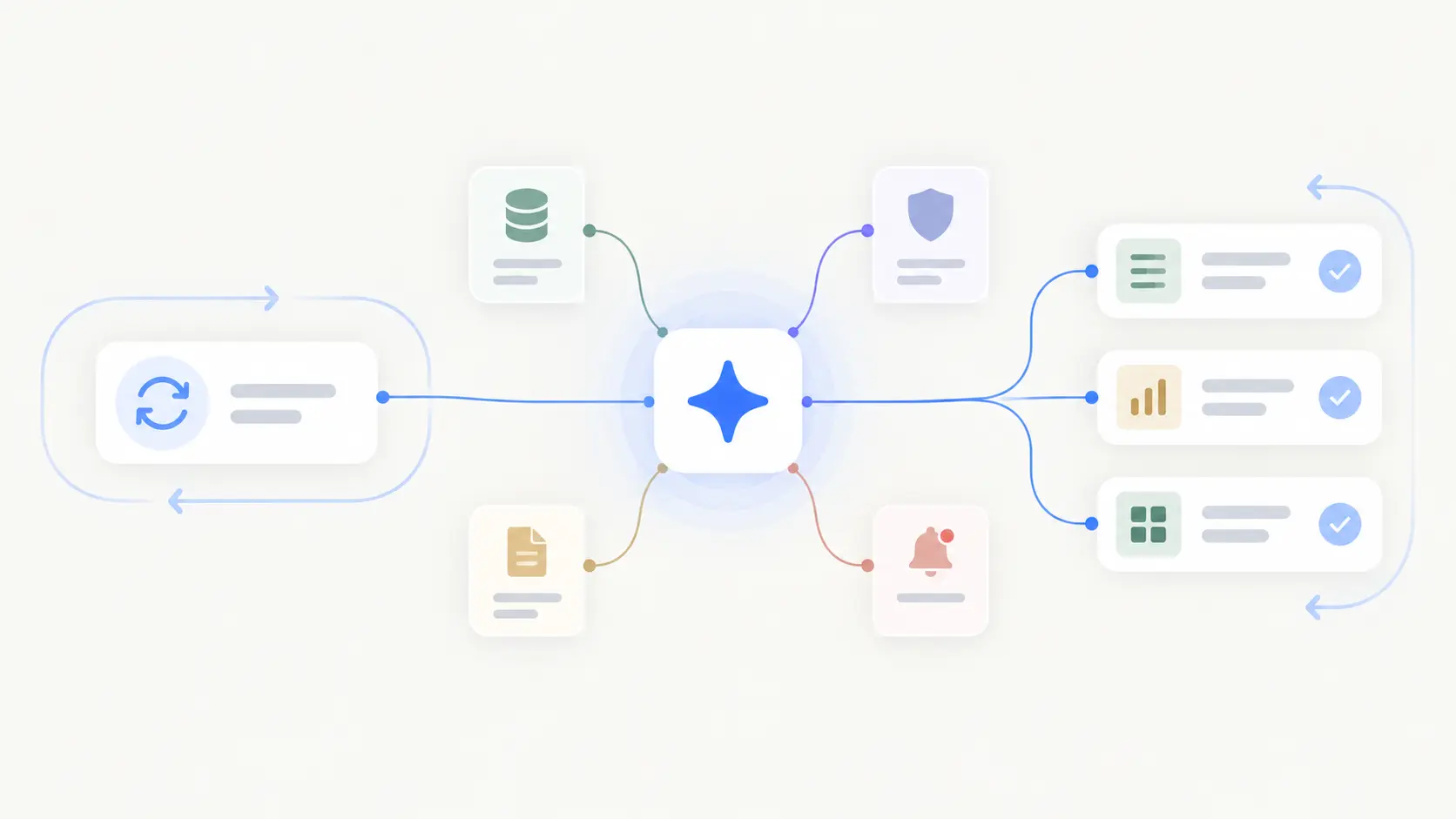
Think of a job you would hand over tomorrow if you had somebody to hand it to.
Not a task. A job. Keeping an eye on which invoices have not been paid and chasing the ones that have not. Watching for anything that needs a real answer this week. Pulling together what you need before every client call.
Those are not requests. They are standing responsibilities, with an outcome, some judgment, and no fixed script. That is what an agent is for, and when it works the effect is the one a good hire has: a whole category of worry moves off your desk.
Getting there is mostly not about the agent.
A deeper walkthrough
The job you would hand over
If a capable person started tomorrow, you would not hand them a task. You would hand them a standing responsibility. Keep the pipeline moving. Make sure nothing goes unanswered for more than a day. Handle the parts of onboarding that do not need me.
Each of those has three things in common. There is an outcome rather than a list of steps. Getting there takes some judgment about the particular case. And it keeps going, so it is not finished when one thing is done.
That is the kind of work an agent is for. Everything else here follows from it.
What an agent actually is
An AI agent is software organised around a goal rather than a request.
You ask a chatbot something and it answers. You give an agent an objective and it works out what to do, does something, looks at what happened, and decides what to do next. It keeps going until the goal is met or it hits something it cannot handle.
That cycle is the whole thing. Look, act, check, decide again.
In human terms it is closer to bringing in a specialist for one function than asking a colleague a question. You do not tell a bookkeeper each step. You tell them what you need and what the limits are, and they work out the rest.
It is also why working with one feels different. You are not getting an answer, you are getting an attempt. Sometimes several. What comes back is an account of what happened rather than a piece of reasoning.
If the boundary with automation is what you are after, which is the other thing this word gets used for, What is the difference between an AI agent and an AI automation? covers it properly.
What changes when it can have a go
A single answer either helps or it does not, and either way you can see it in front of you.
Something that keeps going is different. It can adapt, which is the point: the agent chasing invoices can notice that one client always pays on the last day and treat them differently, without anyone having written that rule.
It can also build on a mistake. If the second step rested on a wrong reading of the first, everything after inherits that and keeps going, sounding entirely reasonable the whole way.
So the trade is not capability against cost. It is adaptability against predictability. An automation does the same thing every time, which is limiting and easy to check. An agent does whatever the situation calls for, which is powerful and much harder to verify, because there is no fixed thing it was supposed to do.
What it looks like when this works
Worth picturing, because the demos oversell it one way and the sceptics oversell it the other.
It is Tuesday and you have not thought about unpaid invoices in three weeks. Not because you stopped caring. Because the ones that needed chasing got chased, the two that were genuinely awkward came to you with the history attached, and the rest sorted themselves out without reaching you.
That is what a good hire actually gives you. Rarely more output. Usually a whole category of worry moving off your desk.
The interesting question is what it takes to get that more than once.
Where they genuinely earn their keep
Four patterns, all of them standing responsibilities rather than tasks.
Ongoing watch. Something that needs checking regularly where most checks find nothing. Unpaid invoices, quiet clients, deadlines drifting. Good for an agent because the cost of a person doing it is mostly the interruption.
Multi-step work with judgment in the middle. Researching a prospect properly. Preparing a proposal from scattered inputs. The steps are knowable and which ones apply depends on what you find.
Front-line handling with a clear escalation. Routine questions answered, anything unusual passed up with the context attached.
Work that spans systems. The thing that needs looking in three places and putting the answer somewhere else.
What those share: a real outcome, recoverable mistakes, and enough repetition to be worth setting up.
Why the first one works and the fourth one does not
Here is the pattern almost everyone runs into, and it is worth understanding before you hit it rather than after.
The first agent goes well. You pick something that has been nagging at you, you give it what it needs to know, you watch it for a fortnight, and it works. The relief is real.
So you build a second. That one needs to know about your clients too, so you tell it again. And a third, which needs to know your standards, so you write those out again. By the fourth you are maintaining four separate explanations of the same business, four sets of permissions, four places to check, and four different ideas of what is currently true.
Nothing has gone wrong with any individual agent. What has gone wrong is that each one is an island, and you are the only bridge between them.
This is the point where people quietly stop. Not because agents disappointed them, but because managing four of them turned out to cost more than the work they took away. You wanted a team and you got four contractors who have never met, all of whom report only to you.
The ways they go wrong quietly
Automation fails by stopping, which is loud and easy to fix. Agents fail in ways worth naming, because none of them look like failure while they happen.
They build on a wrong start. A mistaken reading early becomes the foundation for everything after it.
They take you literally. You asked it to reduce unanswered emails. It now sends unhelpful holding replies, which does reduce unanswered emails.
They act on something they guessed. It is allowed to update a record, so it updates the record, using a value it inferred rather than knew.
They keep trying. Fails, varies, fails again, continues, costing money throughout.
They report well. Ask what it did and you get a clean account. Accounts are generated too.
All five produce output that looks right. So the question about any agent is never only what it can do. It is how you would find out it had gone wrong.
What makes an agent trustworthy is not in the agent
Think about what a new person actually gets from a company on their first day, beyond a desk and a login.
They get told who the clients are and what has happened with each of them. They get limits: what they can spend, what they can sign, what they have to check first. They get someone to go to when something does not fit the usual pattern. And there is some way for you to see the work is getting done without standing over them.
None of that is a quality of the person. You could hire someone excellent and, without those four things, they would still be guessing, overstepping, stuck, or invisible.
Agents are no different, and this is the part that gets skipped, because an agent arrives as software and software feels like it ought to be self-contained.
Go back through what the fourth one was missing. It needed to know who your clients are, which your business knows and the agent does not. It needed limits on what it could do without asking. It needed somewhere to escalate to, with enough context that handling the exception takes two minutes rather than twenty. And it needed someone to notice when it stopped being right, which is not the same as noticing when it breaks.
Context, authority, escalation, visibility. Not one of those sits inside the agent, which is why a more capable one fixes none of them.
That is the whole case for having something underneath. It is the difference between hiring a fourth contractor who has never met the other three, and adding a fourth person to a team that already has a way of working.
How many you actually need
Fewer than the enthusiasm suggests.
Most small operations do well with a small number of agents holding real responsibilities, rather than a dozen with names. Before creating another one, ask whether you could write its job description, and whether anything would notice if it stopped working.
If you cannot answer both, you are not adding capacity. You are adding something to watch.
There is a structural question once you have several, about who answers to whom and what that does and does not imply about access. The complete guide to AI operating systems covers it, and the short version is that reporting to someone does not mean seeing what they see.
Where this is going
Two shifts worth watching. Neither is mainly about the models.
Agents are getting better at knowing when they are out of their depth. That matters more than raw capability, because one that stops appropriately can be trusted at a level an overconfident one never earns.
And they are moving from standalone things you configure toward roles inside something that already knows your business. That is the larger change, for the reason above: most of what makes an agent unreliable is missing context rather than insufficient intelligence, and you cannot prompt your way around not knowing which client this is.
Why we built EverydayOS this way
We treat agents as roles inside an operating system rather than as products you assemble, because of the fourth-agent problem.
A folder of capable agents, each holding a fragment of your business, each governed separately, each checked somewhere different, recreates the coordination burden they were supposed to remove.
EverydayOS is built so agents draw on the same context everything else does, escalate through the same path, and are governed by the same rules about what may happen without asking. The practical effect is that the second responsibility you hand over costs far less to set up than the first, because most of what it needed was already there.
What that makes possible is the Tuesday described earlier, more than once. Several standing responsibilities genuinely off your desk, without the number of things you are watching climbing at the same rate.
Where to start
- Name one standing responsibility you would hand a person. Not a task.
- Check whether you could describe the path. If you can, you want an automation.
- Write what good looks like. If you cannot, you will not be able to tell whether it is working.
- Give it context before authority. Who the people are, what the work is.
- Start at preparation. Let it do everything up to the irreversible step.
- Decide how you would find out it broke. Before you build it.
What actually changes
Check in a month, and check for the right thing.
Not how much the agent did. Whether a category of work stopped reaching you, and whether you stopped checking that it was happening.
That second half is the real test. An agent you still monitor daily has moved the work rather than taken it. One you have genuinely stopped thinking about, because the exceptions come to you and the rest does not, is doing what a good hire does.
You notice it the way you notice any good delegation. Not as a burst of productivity. As something you used to worry about on a Sunday and now do not.
Put AI to work around what matters most
Join early access to EverydayOS and help shape an AI operating system that can coordinate the essential things across your work and everyday life, without making you manage another pile of disconnected AI tools.
Join Early Access