The complete guide to AI assistants: what they can do, where they fall short, and what comes next
What they are good at now, the five places they consistently break down, and what changes when one is given real context
David Daniel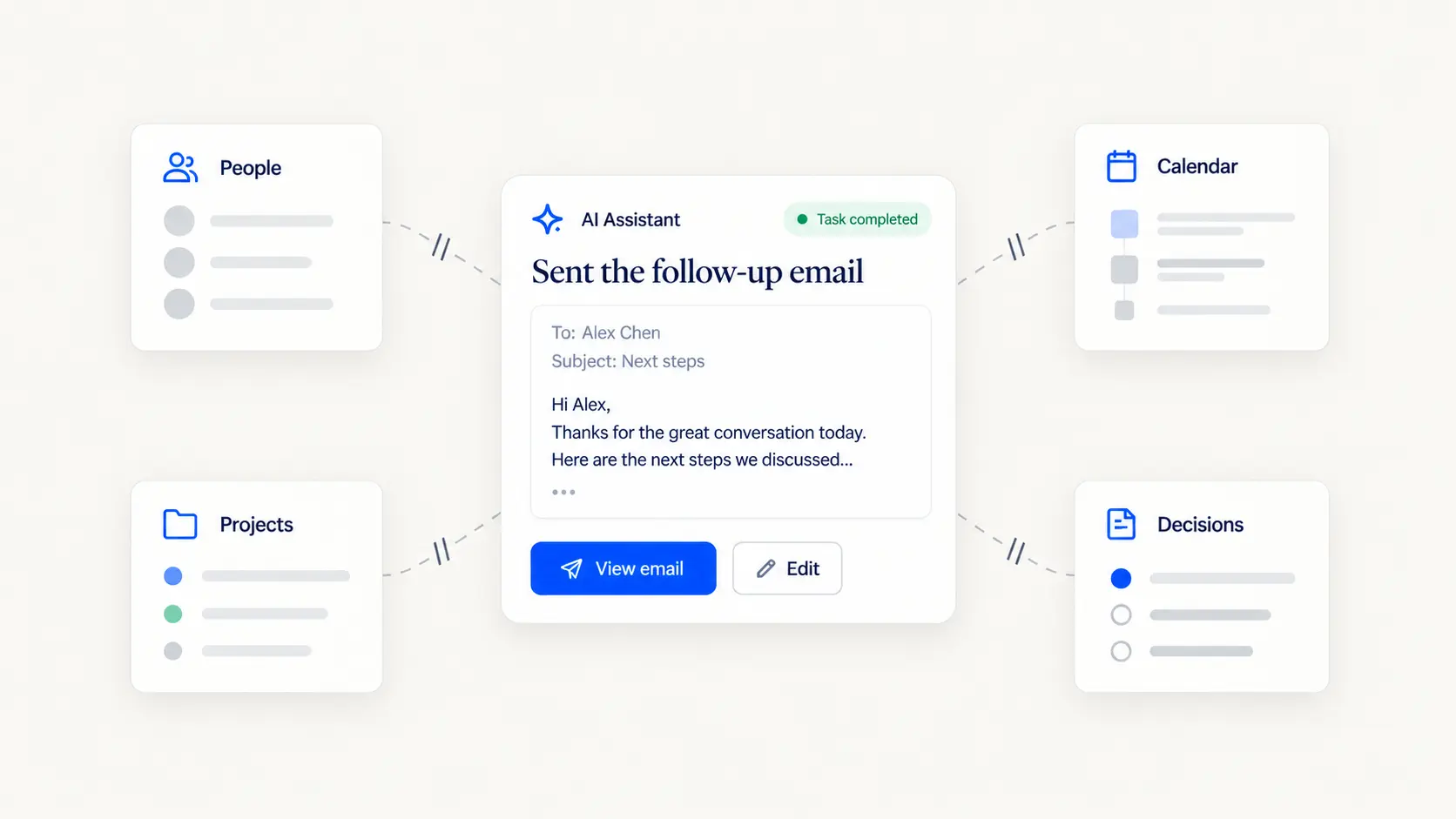
An AI assistant is software you ask for help, in ordinary language, with the kind of work that used to mean sitting down and doing it yourself.
They have got good. Genuinely good. The gap between what one can do in a single sitting and what it does for your business over a month is where the frustration lives, and that gap has almost nothing to do with how clever the model is.
This covers what assistants are actually good at now, the five places they consistently fall down, and what has to change before one can carry real responsibility. If you want the definition and how an assistant differs from a chatbot or an agent, the Answer What is an AI assistant? covers that more directly.
A deeper walkthrough
The strange thing about a capable assistant
Most people's experience follows the same shape.
The first few weeks are impressive. It writes the difficult email in thirty seconds. It explains the contract clause. It turns your rambling voice note into a clean summary. You start telling people about it.
Then something quieter happens. You notice you spend the first two minutes of every session explaining the same things. Which client. Which business. What you decided last month. What you already tried. You are not getting less value. You are doing a job you did not sign up for, over and over, and you are the only one who can do it.
That pattern is worth understanding before you decide how much to lean on one. The assistant is not underperforming at the task. It is missing everything around the task.
What they are genuinely good at now
Worth being specific, because the useful cases are real and plenty of people are still underusing them.
Turning a mess into a first draft. Meeting notes into a summary. Scattered thoughts into a proposal outline. A long thread into a plain statement of what the client is actually asking for. Getting from nothing to something is where most of the friction in written work lives, and this removes it.
Explaining things you do not want to look up. What this contract term means. How the tax treatment usually works. It will not replace your accountant and it will get you to the right question much faster.
Thinking something through out loud. Pricing a new service. Deciding whether to take a client. Working out how to handle a difficult conversation. It is a decent thinking partner precisely because it is not invested in the outcome.
Working through documents. Reading the fifty-page report and pulling out what matters. Comparing three proposals against the same criteria. Finding the clause you half remember.
Handling the words you do not want to write. The follow-up. The polite decline. The third reminder about an invoice.
None of that is small. For a lot of one-person businesses it is worth more than the subscription on its own.
Where they fall short
Once you move past occasional use and start leaning on one, the same five problems show up. These are not bugs. They are what happens when a capable tool has no operating context.
It starts further back than you would like. Memory features have improved this, and most of what they hold are facts you stated rather than the shape of how your business runs. Too much of the background still gets rebuilt one conversation at a time.
It does not reliably know which of you it is talking to. If you run two companies, or a business and a household, the assistant has little to go on when working out which world a question belongs to. You compensate by being careful in how you phrase things, which is you doing the filing.
It struggles to tell what is still true. It will confidently use something you told it in March that stopped being true in June. Facts do not expire on their own, and nothing is tracking which version is current.
Work stalls on its way out of the conversation. Some assistants can take actions through connected tools now, so this is no longer a flat no. What is still rare is carrying something the whole way: doing it in the right account, under permission that fits the situation, and leaving a record you can check afterwards. So the last step usually comes back to you. People underestimate this one, because it feels small each time and adds up to most of the friction.
It helps with what you bring it. Most assistant use is still request-driven. It will not mention that the decision from Monday's call never turned into anything, or that the client who always pays on time has gone quiet, because nothing is watching for that between conversations.
Why a smarter model does not fix this
This surprises people, so it is worth being direct.
Go back through those five. Starting further back. Not knowing which business. Not knowing what is still true. Work stalling on the way out. Only helping with what you raised.
Not one of them is a case of the AI not being clever enough. A model twice as capable, in the same setup, has exactly the same five problems. It will write a better email and still not know whether it was sent.
These are questions about state, identity, time, authority and attention. They are the questions a business answers in how it is structured rather than in who it hires. Which is why we think the interesting work now is happening in the layer underneath the assistant rather than in the assistant itself.
The comparison that makes this concrete
Think about a temp and someone who has worked for you three years.
The temp can be excellent. Sharp, fast, good instincts. And every morning you explain the business again, because they were not there yesterday.
The person who has been there three years is not smarter. They have context. They know which client goes quiet before they complain. They know you do not book anything before ten on Mondays. They know why you stopped using that vendor, which is written down nowhere. That context is most of what makes them worth more.
Most AI assistants today are the temp. Very capable, no accumulated understanding of your business. The question worth asking of any assistant is not how clever it is. It is whether it can ever become the three-year employee.
What an assistant needs before it can carry real weight
Four things. They map closely onto what you would give a person.
Context. What it needs to know about the situation around the request. Which client, which project, what was already decided, what is going on this week.
Memory it can be trusted with. Durable understanding that survives the conversation ending. The important part is that you can correct it and that it knows where things came from.
Access to where the work lives. Your calendar, your inbox, your projects. An assistant that cannot see your actual week can only ever help in the abstract.
Permission. What it may look at, what it may draft, what needs your yes, and what it can handle on its own. This is a separate question from access, and it is the one people skip.
That fourth one deserves a moment. Giving something the ability to see your inbox is not the same as giving it permission to speak for you. You know this instinctively with people. Your bookkeeper sees every invoice and cannot move money. The new hire has a key to the building and cannot sign a contract. Software tends to collapse those into one switch.
How much should you let it do?
It should grow, in one area at a time, the way it does with a person.
A workable progression:
- It tells you. Surfaces what matters, suggests what to do.
- It prepares. Drafts the message, assembles the schedule, puts it on your desk.
- It does it once you say yes. The approval covers that specific thing.
- It handles it. A narrow, defined category you have stopped checking.
Most people jump from the first to the last, usually out of impatience, get nervous, and pull all the way back. Moving through the middle two is slower and is how trust actually gets built.
One rule worth holding onto. The system should never widen its own authority. A run where it performed well is a reason for it to ask whether you want to give it more. It is not a reason for it to take more.
Where the bar should be higher
There is no permanent list of things AI must never touch. Draw one and it will be wrong within a year, and it will be wrong differently for a solo operator than for a fifteen-person company.
The principle that holds up better: the harder something is to undo, the more it costs when it goes wrong, and the more judgment it takes, the higher the bar should be before it happens without you.
In practice that puts a high bar on a few things.
Relationships that matter. It can prepare the message. Whether to send it, and what it costs you if it lands badly, is a judgment about a person.
Pricing and negotiation. It can build the comparison. The final number reflects strategy and nerve.
Anything hard to reverse. Money out, agreements signed, commitments made in your name.
Deciding what matters. The point of handing off coordination is to get attention back for the things only you can weigh.
None of those is permanently off the table. With explicit authority, tight boundaries and a way to check what happened, parts of them can move over time. What should not move is the threshold itself.
What to look for as assistants become more important
Most comparisons rank models. That is the least useful thing to compare, because the capability gap between the serious options is smaller than the gap between one that knows your business and one that does not.
Better questions:
- Does it remember, and can you see and fix what it remembers? Memory you cannot inspect is memory you cannot trust.
- Can it handle more than one account without mixing them up? If you have two businesses, or a business and a household, this is not optional.
- Does it distinguish looking, preparing and doing? One permission switch is a bad sign.
- Can it reach the places your work actually lives?
- Does what it knows travel with you? If everything sits inside one provider, changing provider costs you the understanding you built.
- Does it reduce what you manage? A setup that needs constant supervising has moved the work rather than removed it.
Where this is going
The direction is reasonably clear. It is not mainly about the models.
Assistants are moving from something you open toward something that runs in the background, holds the picture of what is going on, notices what changes, and can be trusted with a widening but defined set of actions. Less like a tool you use and more like someone who works for you.
That shift needs things a tool does not have. Somewhere for durable context to live. A way of knowing which world a question belongs to. A record of what was decided. Levels of authority. A way of acting in the systems where the work happens.
Which is the case for an operating layer underneath the assistant, covered in The complete guide to AI operating systems.
Why EverydayOS is designed this way
We think the assistant is the relationship and the system underneath is what makes it durable. You should talk to one thing. That one thing should not have to personally contain every piece of memory, every connection, every specialist capability and every permission rule.
The commercial reason is simple. If your context lives inside one AI provider, you are renting the understanding you built. Models will keep changing. What you know about your clients and your decisions should outlast whichever one is best this year.
So EverydayOS is built around the layer rather than around the assistant. Durable context you can see and correct. More than one account, kept apart. Projects and decisions held as records rather than as conversation history. Levels of authority that are granted rather than assumed.
What that changes for you is the part that compounds. An assistant starting fresh is worth roughly the same in year two as it was in week one. One sitting on an operating layer gets more useful the longer it runs, because what it works from accumulates instead of resetting.
Your action plan
For one week, keep four lists.
- What you repeatedly explain. The background you retype into every new conversation.
- What you repeatedly carry between tools. Every time you copy something out of the AI and into something else.
- What you repeatedly check. The things you go and verify because you do not trust that they happened.
- What you repeatedly remember on the AI's behalf. The context it should have held and did not.
Those four lists are the work an operating layer has to absorb. They are also a fair test of whether you need one yet. If all four are short, an assistant is doing fine. If they are long, and the same items keep reappearing, you are already doing the job by hand.
If you want to go deeper on the first list specifically, read What an AI assistant needs to actually understand your life and work.
Put AI to work around what matters most
Join early access to EverydayOS and help shape an AI operating system that can coordinate the essential things across your work and everyday life, without making you manage another pile of disconnected AI tools.
Join Early Access