
What should a solopreneur automate with AI, and what should stay human?
A practical framework for deciding what AI should handle and where human judgment still creates the most value
David Daniel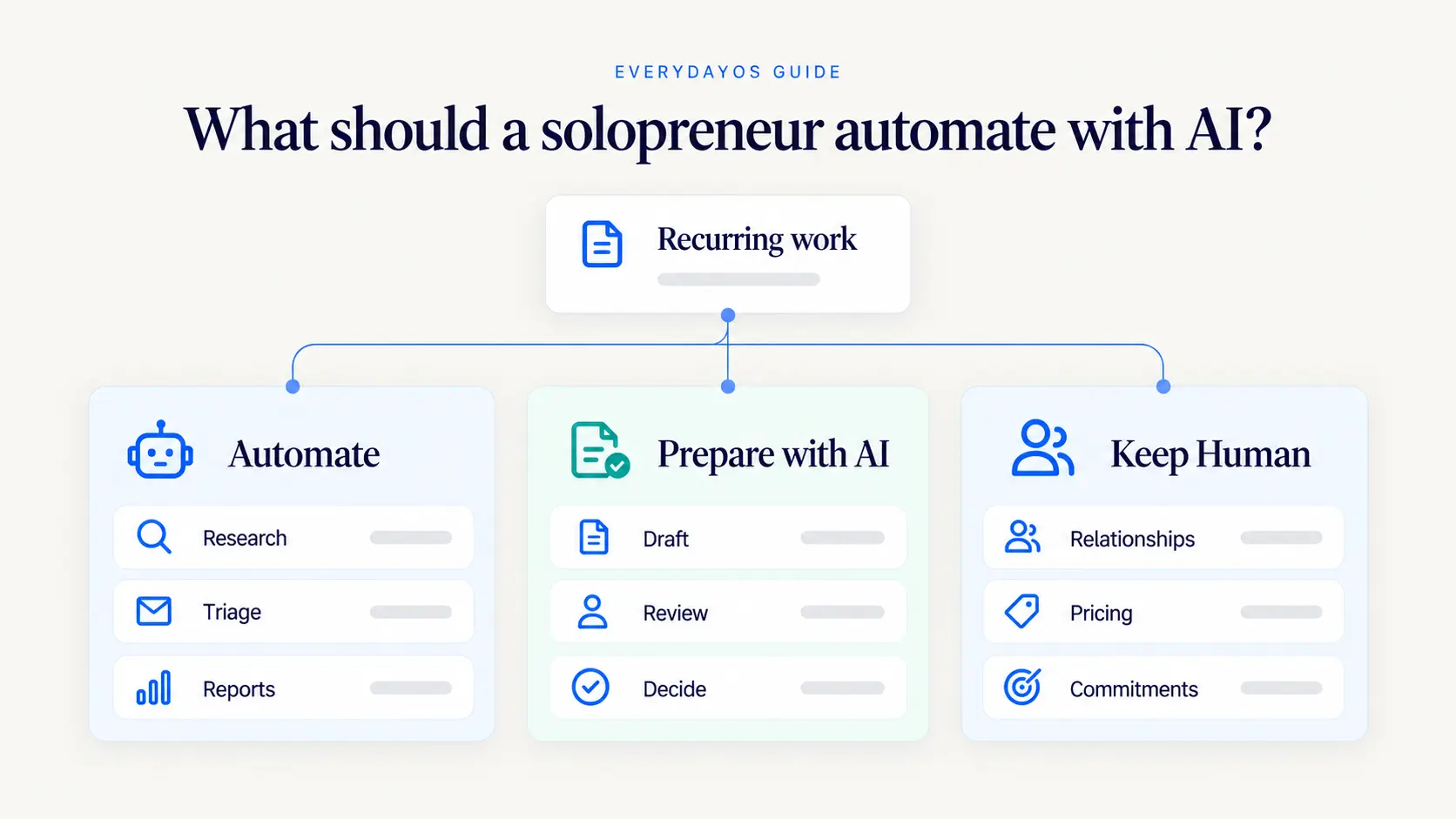
A solopreneur should automate work that is repeatable, context-bounded, easy to verify, and expensive in time relative to the judgment it requires.
The work that should stay human is usually relationship-sensitive, identity-shaping, ambiguous, high-consequence, or dependent on judgment you would not comfortably delegate without context.
The goal is not maximum automation. It is better stewardship of your time and attention.
EverydayOS is designed around that reality. AI should create operating capacity without turning the owner into the full-time manager of a stack of automations and bots.
A deeper walkthrough
Start with the work that repeats
Good automation candidates often have a recognizable pattern:
- the trigger is clear
- the inputs are predictable
- the desired outcome is known
- the exceptions are limited
- the result can be checked
Examples might include turning meeting notes into proposed follow-up, drafting recurring client updates, preparing a daily or weekly operating brief, classifying inbound messages, creating first-pass research summaries, preparing social derivatives from approved source content, reminding you about open commitments, and assembling standard reports.
These tasks consume time, but they do not always deserve your best thinking.
Automate coordination before judgment
Solopreneurs often try to automate customer-facing output first because it feels tangible.
There is another category that is frequently safer and more valuable: coordination work.
Think about the time spent asking:
- What is due today?
- Who am I waiting on?
- What did I promise in that meeting?
- Which lead needs a follow-up?
- Did I send that proposal?
- What changed while I was working on something else?
These are ideal areas for an AI Chief of Staff or operating layer because the system is reducing mental load without necessarily making the final business decision.
A five-part automation test
Before automating something, score it on five dimensions.
1. Repetition
Does the same basic situation happen often enough that automation will repay the setup cost?
2. Judgment
How much context and discretion does a good decision require?
3. Consequence
What happens if the AI gets it wrong?
4. Reversibility
Can the action be undone easily?
5. Verification
Can you tell reliably whether the work was completed correctly?
Automation becomes much safer when success can be verified objectively. EverydayOS uses these kinds of boundaries because capability should not automatically become authority.
What to automate first
For many solopreneurs, strong early candidates include:
Research and preparation
Let AI gather, organize, compare, summarize, and prepare the first pass.
Meeting follow-up
Turn notes into proposed decisions, commitments, tasks, and follow-up drafts.
Inbox triage and drafting
Let AI identify what needs attention and prepare responses. Keep approval where the message changes scope, pricing, a promise, or an important relationship.
Content repurposing
Once a canonical article, offer, or point of view is approved, AI can create derivative drafts for email, social, video, or other channels.
Routine operating reports
AI can gather the current state and prepare the report. You can spend your time deciding what the report means.
What should usually stay human?
Important relationships
AI can prepare context and drafts, but key client, partner, employee, and personal relationships deserve human ownership when nuance matters.
Pricing and negotiation
AI can research options and prepare scenarios. The final tradeoff often reflects strategy, positioning, and relationship dynamics.
Major commitments
Deadlines, scope changes, contracts, hiring decisions, and material spending should have clear human authority unless you have explicitly delegated a narrow class of decisions.
Creative direction
AI can generate options quickly. But the question “Is this us?” is still a judgment about brand, taste, and identity.
Deciding what matters
A solopreneur should use AI to reduce the work of carrying priorities, not outsource the purpose of the business or life around it. EverydayOS is designed to help keep the essential things visible and coordinated, but the definition of what is essential ultimately belongs to the person.
Do not automate chaos
If a process changes every time you do it, automating it may create more exceptions than savings.
Before automating, ask whether the work itself is clear.
Sometimes the right first step is to define the trigger, outcome, decision owner, inputs, exception path, and approval threshold. Then automate the stable parts.
Your action plan
Do a 30-minute automation audit.
- Write down the recurring work you did this week. Include admin and coordination, not just production work.
- Mark each item low, medium, or high judgment.
- Mark the consequence of failure. Low, moderate, or high.
- Circle the work that is repetitive, low judgment, low consequence, and easy to verify. Start there.
- For medium-judgment work, automate preparation rather than execution. Let AI draft, classify, summarize, or recommend.
- Keep high-consequence or relationship-sensitive actions behind approval.
- Measure whether the automation actually returns time. If you spend as much time supervising it as doing the work, redesign it.
If your next question is how to organize the AI roles around your business, read How to Use an AI Chief of Staff When You Are the Whole Leadership Team. It helps turn isolated automations into an operating model.
If you want AI to create more capacity without making your business or everyday life feel more fragmented, that is the problem EverydayOS is built to solve. Join early access.
Put AI to work around what matters most
Join early access to EverydayOS and help shape an AI operating system that can coordinate the essential things across your work and everyday life, without making you manage another pile of disconnected AI tools.
Join Early Access