The complete guide to building an AI workforce: humans, agents, roles, and how capacity actually grows
What changes when capacity stops arriving one person at a time
David Daniel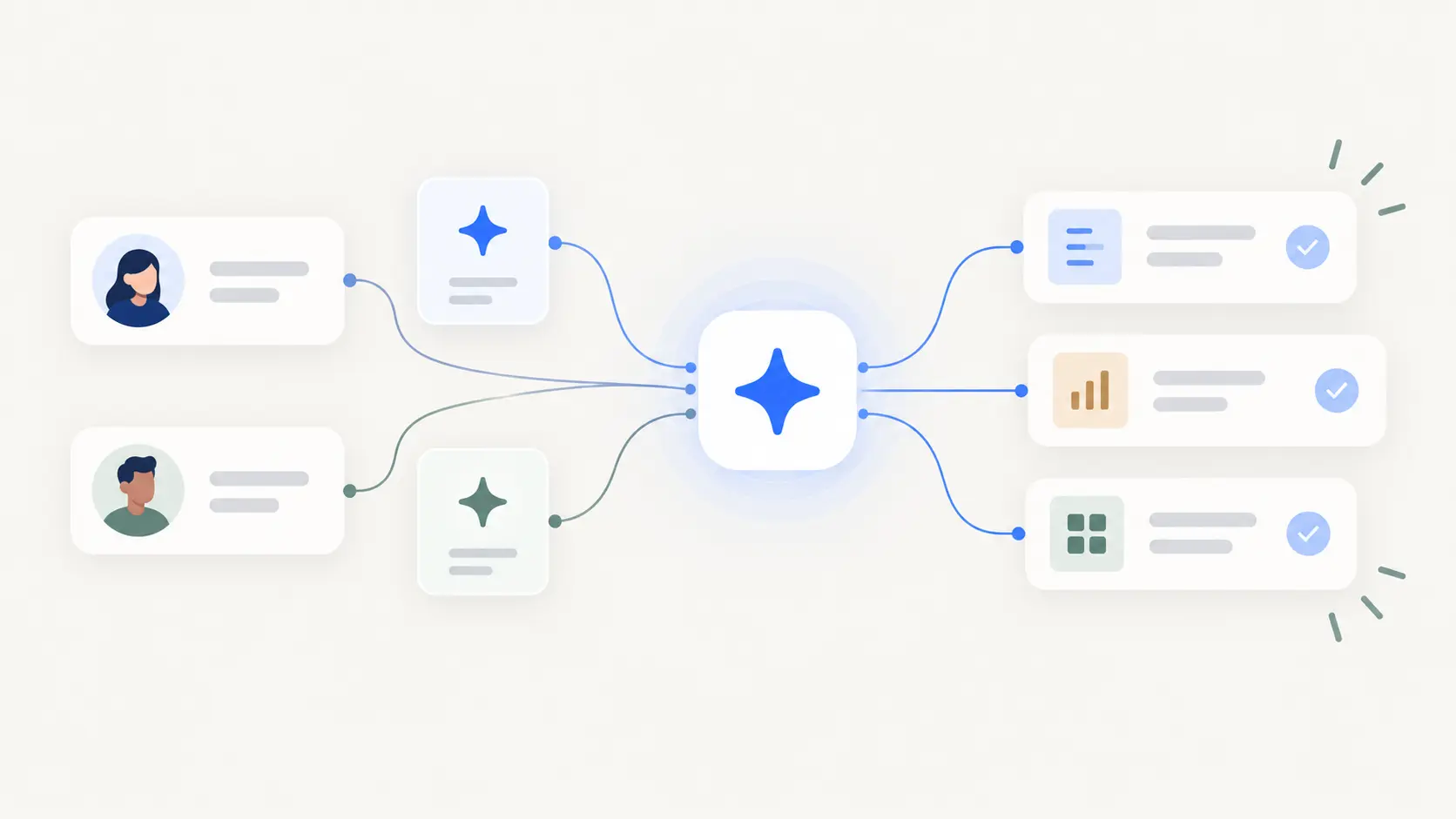
Until recently, more capacity meant another person. That was the only unit available, and it came with everything attached: salary, management, onboarding, the risk of getting it wrong.
There is now a second unit. It is cheaper, it arrives instantly, it never gets tired, and it is worse than a person at almost everything that requires judgment, relationship or accountability.
Which means the interesting question is not whether to use it. It is what shape your capacity should be, given that you now have two kinds to build with and they are good at different things.
A deeper walkthrough
The point where you cannot hire your way out
Most businesses hit the same wall. There is more work than the people can do, and the obvious answer is another person, and the numbers do not support one yet.
So you carry on. Everyone absorbs a bit more. The owner takes the overflow, which is how owners end up doing invoicing at eleven at night. The work that is important and not urgent stops happening, because there is no room for it.
That gap, between needing more capacity and being able to afford a person, is where most small businesses spend most of their life. It is not a temporary state before the next hire. For a lot of businesses it is the permanent condition.
It is also the thing an AI workforce actually addresses, which is a more modest claim than the usual one and a more useful one.
What an AI workforce actually means
The phrase suggests a staff of robots. What it means in practice is a lot less sci-fi.
It is the work your business gets done without a person doing it. Some of that is agents holding standing responsibilities. Some is automation running defined processes. Some is the layer that keeps track of what everyone knows.
The useful framing is that it is capacity, not software. Software is something you use. Capacity is something that does work whether or not you are thinking about it, which is the whole difference and the reason this needs different habits from buying a tool.
A workforce includes the people. The moment you have both, you are not running a team and some software. You are running a team with two kinds of worker in it, and that is an organisational question before it is a technical one.
What it looks like when this works
Worth being concrete, because the version in the marketing is a fantasy and the version in practice is genuinely good.
A three-person business operates with the coordination of a ten-person one. Nothing is dropped, because something is watching. Client work gets prepared before anyone touches it, so the people start further along. The owner's week has room in it for the work only they can do.
Nobody has been replaced. What has happened is that the business stopped losing capacity to the gaps: the things that waited for someone to remember, the work that sat because the person who could move it was busy, the follow-up that never happened.
And the number the owner notices is not output. It is that they stopped having to hold everything, and the business got less dependent on any one person at the same time.
Capacity is now something you design
This is the shift, and it is easy to miss because it sounds abstract.
Hiring is a blunt instrument. A person is a bundle: they come with judgment, relationships, accountability, availability, and a fixed cost, all at once. If you need more of one of those, you buy the whole bundle.
You can now buy some of those separately. Persistence without judgment. Preparation without accountability. Attention without cost.
That means the design question changes. It is no longer just how many people do we need. It is which parts of this work need a person, which parts need something that never forgets, and which parts should stop happening.
Most businesses have never asked it that way, because until now there was no reason to.
Which roles come first
The pattern across most small businesses is consistent.
The one that watches. Whatever needs checking regularly where most checks find nothing. Unpaid invoices, quiet clients, deadlines drifting. First because it replaces something that currently depends on someone remembering.
The one that prepares. Research, first drafts, meeting preparation, summarising long threads. High value, low risk, immediately obvious.
The one that holds the picture. What is in flight, what changed, what is waiting. This is the Chief of Staff role, and it is the one that makes the others coherent rather than separate.
The specialists. One that owns a function end to end, once there is enough volume in that function to justify it.
Most businesses do that order backwards, starting with a specialist because it is the most impressive, and then find they have a very capable thing in a business that still has no shared picture for it to work from.
What does not change
Three things people expect to go away and do not.
Accountability. An agent can hold a responsibility. It cannot answer for the outcome. Every piece of AI-held work still needs a named person who owns whether it is working.
Management. A workforce needs managing regardless of what it is made of. Deciding who does what, noticing when something is not working, adjusting as things change. That job does not disappear. It changes shape.
A way of working. A team without shared context, agreed boundaries and a route for exceptions is a group of individuals. That is as true when some of them are agents, and it is the thing most people skip because software feels like it should arrive self-organising.
Adding workers without a way of working
This is the failure that catches almost everyone, and it is worth seeing before you hit it.
You add the first agent and it works. So you add a second, which needs the same background explained again. And a third. By the fourth you are maintaining four explanations of the same business, four sets of permissions, four places to check.
Nothing has gone wrong with any of them individually. What has gone wrong is that you hired four people and gave them no induction, no handbook, no manager and no way to talk to each other.
That is the whole argument for an operating layer underneath, and The complete guide to AI agents goes through it properly. The short version: what makes any worker reliable is mostly not inside the worker.
The management job nobody staffs
Every AI workforce creates a management job, and almost nobody accounts for it.
Someone has to notice when something stops working. Someone has to decide when a responsibility should widen. Someone has to keep the context current, because a workforce running on last quarter's picture gets confidently wrong.
In a small business that someone is usually the owner, which is an irony worth naming: you added capacity to get time back and created a supervision job you now do personally.
The way out is not more discipline. It is that the supervision has to be cheap, which means one place to look, exceptions that come to you with the context attached, and visibility into what ran without going to check. If those are not there, the management cost will grow faster than the capacity does.
What it actually costs
Three costs. One of them is on an invoice.
Subscriptions, which are the smallest and the only one anyone counts.
Setup, which is real hours and front-loaded. Mostly spent on making the business legible: who the clients are, what the standards are, what is currently true.
Supervision, which is ongoing and is the one that decides whether this is worth it.
Against those, the return usually is a headcount saving, just not the kind that shows up as somebody leaving. It is the hire you did not have to make, or made six months later, or made for a different role because the one you were about to fill turned out not to be the constraint. That is a real number and it is often the largest one in the calculation.
The second return is that the business stops losing work in the gaps: the things that waited for someone to remember, the follow-up that never happened, the client who went quiet and nobody noticed. Harder to count, and it compounds.
Why we built EverydayOS this way
We treat this as an operating system rather than a collection of workers, because of what happens at the fourth one.
A workforce is not a set of capable individuals. It is capable individuals plus the thing that lets them work together: shared understanding of the business, clear boundaries, somewhere to escalate, and a way to see what happened.
EverydayOS is built so that layer exists once and everything draws on it. A person and an agent hold work the same way, hand it over the same way, and are governed by the same rules about what may happen without asking.
What that makes possible is adding capacity without adding supervision at the same rate, which is the thing that decides whether a small business can actually use any of this.
Where to start
- Write down what the business needs done. Functions rather than tasks.
- Find what currently depends on someone remembering. That is the first candidate.
- Get the shared picture in place before adding workers. Who the clients are, what is in flight, how things are done.
- Add one role, at preparation only, for a month.
- Name the person who owns it. Including when it is an agent.
- Check the supervision cost before adding the second.
What actually changes
The measure worth using is not how much of the work is done by AI.
It is whether the business can take on more without the operational side getting heavier, and whether it has stopped depending on any one person to hold things together.
You notice it in unremarkable ways. A busy month that did not feel like a crisis. A week where someone was away and it was uneventful. Work that used to wait now moving. And the owner spending more of their time on the things only they can do, which is the thing everyone wanted from hiring and rarely got.
Put AI to work around what matters most
Join early access to EverydayOS and help shape an AI operating system that can coordinate the essential things across your work and everyday life, without making you manage another pile of disconnected AI tools.
Join Early Access