
Human and AI teams: who should own what, and how the work moves between them
How to split work between people and AI without pretending they are the same kind of worker
David Daniel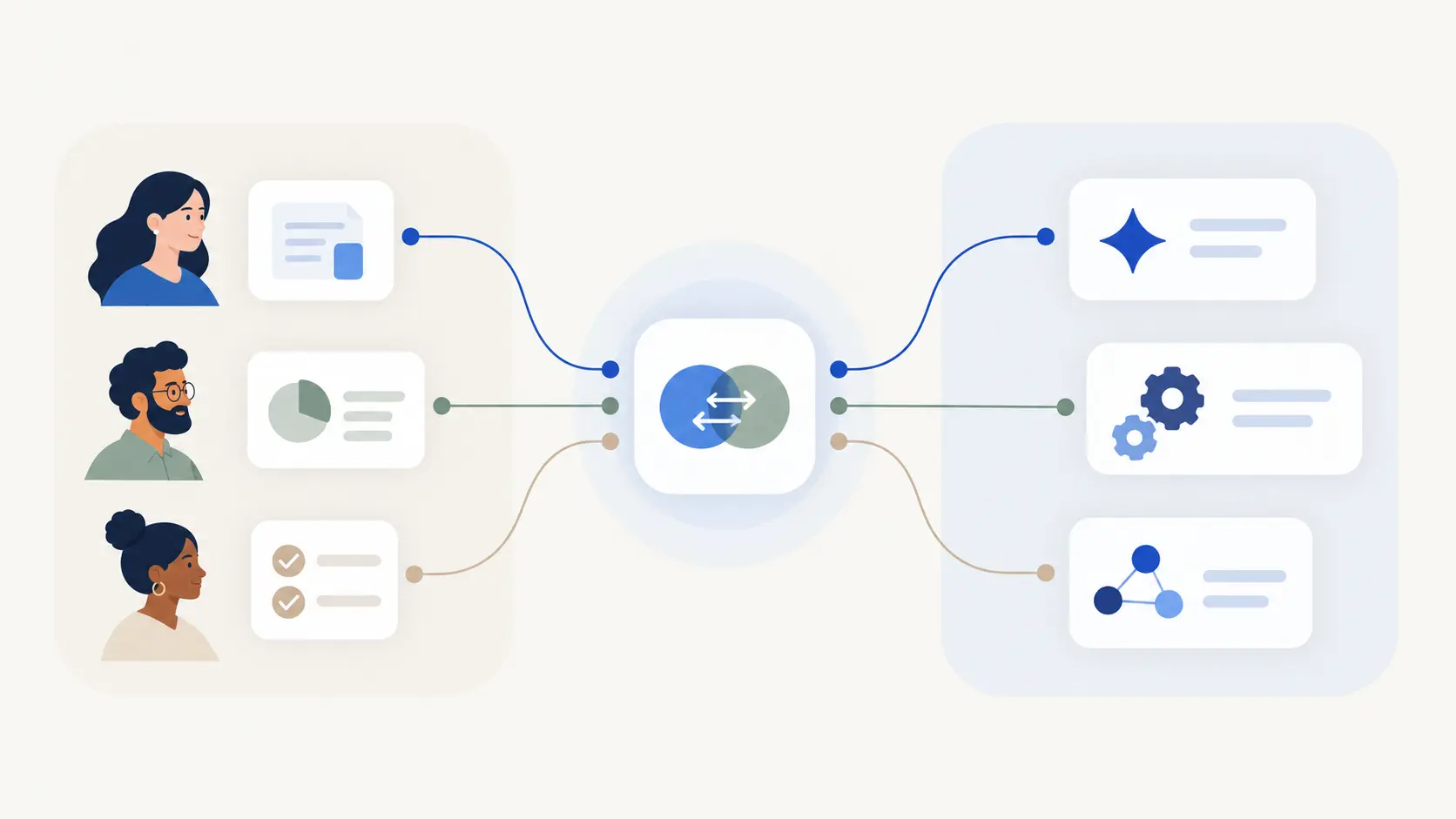
Once AI is doing real work in a business, a question arrives that nobody has good habits for: who does what.
The common answer is that AI takes the repetitive work and people do the thinking. It sounds right and it falls apart immediately, because plenty of repetitive work carries real consequence and plenty of thinking is genuinely routine.
Four questions do better. What does it cost when it goes wrong. How much judgment does it need. Does a relationship depend on it. And does doing it well need context nobody has written down.
Answer those and the split mostly makes itself.
A deeper walkthrough
The question that arrives once AI is actually working
For the first while, AI in a business is a tool people use. Nobody asks who owns what, because the answer is that a person owns everything and uses a tool.
That changes the moment something runs without being asked. A report that produces itself. A follow-up that happens whether or not anyone remembered. At that point AI is not a tool anyone is using. It is doing a piece of the work, and the ordinary questions about work apply.
Who is responsible if it is wrong. Who notices if it stops. What happens when it meets something it was not designed for. Who does the person on the other end think they are dealing with.
Those are staffing questions, and they usually get answered by accident, because nobody notices they are being asked.
Why "AI does the boring parts" is not a split
It is the intuitive answer, and it breaks down quickly.
Plenty of repetitive work carries real consequence. Sending the invoice is repetitive. Sending it to the wrong client is not a small problem. Following up is repetitive. Following up with the client who complained last month, in the standard tone, is a mistake.
And plenty of work that feels like thinking is routine. Reading a long thread and working out what was agreed feels like judgment because it is effortful. It is mostly comprehension, and it is a good candidate for handing over.
Sorting by how interesting the work is sorts by how it feels to the person doing it, which has nothing to do with where it should sit.
What to sort on instead
Four questions, in the order that decides most cases.
What does it cost when it is wrong? The single most useful question. Recoverable in ten seconds, or a phone call you dread. Everything else is secondary to this.
How much judgment does it need? Not difficulty. Judgment, meaning that two reasonable people might decide differently and the reason is values or strategy rather than information.
Does a relationship depend on it? Some work is partly about the fact that a person did it. A condolence note. A difficult conversation with a long-standing client. The output is not the whole point.
Does it need context nobody has written down? If doing it well depends on knowing things that live only in someone's head, it stays with that person until the context exists somewhere else. That is a system problem, and it is fixable, which makes it different from the other three.
Most work sorts cleanly on those four. The cases that do not are usually work nobody has defined, and that is the finding rather than the problem.
What it looks like when the split is right
Nobody on the team talks about which things are done by AI. They talk about whether the work got done. The distinction has stopped being interesting, the way it stops being interesting whether the invoices go out by post or by email.
The people are spending more of their week on the parts that need them, because the surrounding work stopped landing on them first.
Handoffs happen without meetings. When something goes wrong it is obvious quickly, and obvious who picks it up.
And the thing a client notices is that they get answers faster and the answers are right, with no sense that they are being handled.
What people should keep
Three categories.
Work where being human is the point. The relationship parts. Not because AI cannot produce the words, but because who wrote them is part of the message.
Decisions about direction. What matters this quarter. Which client to invest in. What you will not do. Those are the substance of running a business and they are not overhead.
The final call on anything hard to undo. Money out, commitments made in your name, anything a client will act on.
Everything else is genuinely open, and where the line sits will move as the system earns more trust in specific areas. That is the correct behaviour rather than a compromise.
What people gain
Talking only about what humans keep makes this sound defensive, which it is not.
When the split works, people spend more of their time on the work that is actually theirs. The client-facing person does more client work and less preparation for it. The person who is good at the difficult conversations has more room for them, because they are not also chasing invoices.
That is the case for doing this at all. Not fewer people. The same people, doing more of the thing you hired them for.
What changes about managing
Three things behave differently when part of the team is not human.
Accountability stays with a person. An agent can hold a responsibility. It cannot be accountable, because accountability means someone answers for the outcome. Every piece of AI-held work needs a named human who owns whether it is working.
Trust does not transfer. With a person, good judgment in one area is reasonable evidence about another. With AI it is not. Excellent invoice chasing tells you nothing about how it would handle a complaint. Trust has to be earned area by area.
Nobody notices quiet failure. A person who stops doing part of their job becomes obvious. Something that stops running does not, unless someone is watching for absence rather than for errors.
The handoff is the whole thing
The difference between a hybrid team that works and one that generates constant friction is almost entirely in the handoffs.
When a person hands work to another person, a lot travels invisibly: what was tried, what the client is like, what to be careful of. When work passes to or from AI, none of that is implicit. It has to actually exist somewhere.
So the practical test of whether a hybrid team will work is not what the AI can do. It is whether work can move between a person and an agent without either of them losing the plot.
If a person picking up from an agent has to reconstruct what happened, the handoff is broken. If an agent picking up from a person has to be told the background every time, the same is true. Either way you have two workers and no team.
The failures are all things you would never accept from a person
Every way a hybrid team goes wrong has a human equivalent you would spot in a week.
You would not give someone a responsibility and then have nobody notice whether they were doing it. Yet AI-held work routinely runs unowned, because software feels like it ought to look after itself. It runs until it does not, and the gap between those two states can be months.
You would not decide that because a new hire was good with invoices they could now speak to clients. With people you know that competence in one area is weak evidence about another. With AI the temptation is stronger, because one good month reads like a general verdict, and the first bad week tends to arrive in the area nobody tested.
You would not let information travel in one direction only. That one is common: agents inherit everything the business knows, while what the agent actually did is visible to nobody. Handoffs work going out and break coming back, and the person picking up is left reconstructing.
You would not keep a second person quietly doing the same job in case the first one is unreliable. Teams do exactly this, running the old process alongside the new one, paying for both while neither becomes the real one.
And you would not hire someone and never revisit what they are responsible for. The split between people and AI should move as trust is earned in specific areas. Set once and left alone, it ends up either too cautious to be worth having or too generous to be safe.
So the test is straightforward. Look at how the AI-held work is being managed, and ask whether you would accept that arrangement from a person.
Why we built EverydayOS this way
We treat humans and AI as occupying roles in the same structure rather than as two separate systems that have to be integrated.
The reason is the handoff. If AI work lives in one place with its own record and human work lives in another, every handoff is a translation, and you get the friction described above no matter how good either side is.
EverydayOS is built so a piece of work can be owned by a person or by an agent and look the same either way: the same record of what happened, the same history travelling with it, the same rules about what may happen without asking, and the same place to see whether it got done.
What that makes possible is a team that can move work to whoever should have it, including when that changes, without rebuilding anything.
What actually changes
The measure worth using is not how much of the work AI took.
It is whether the people are spending more of their week on the things only they can do, and whether the work moving between them and the system does so without anyone losing track.
You notice it when the distinction stops being interesting. Nobody asks whether a thing was done by a person or not. They ask whether it was done well, which is the question they would ask about any colleague.
Put AI to work around what matters most
Join early access to EverydayOS and help shape an AI operating system that can coordinate the essential things across your work and everyday life, without making you manage another pile of disconnected AI tools.
Join Early Access