
How to set up AI across a small team
Getting it to help the business rather than five people separately
David Daniel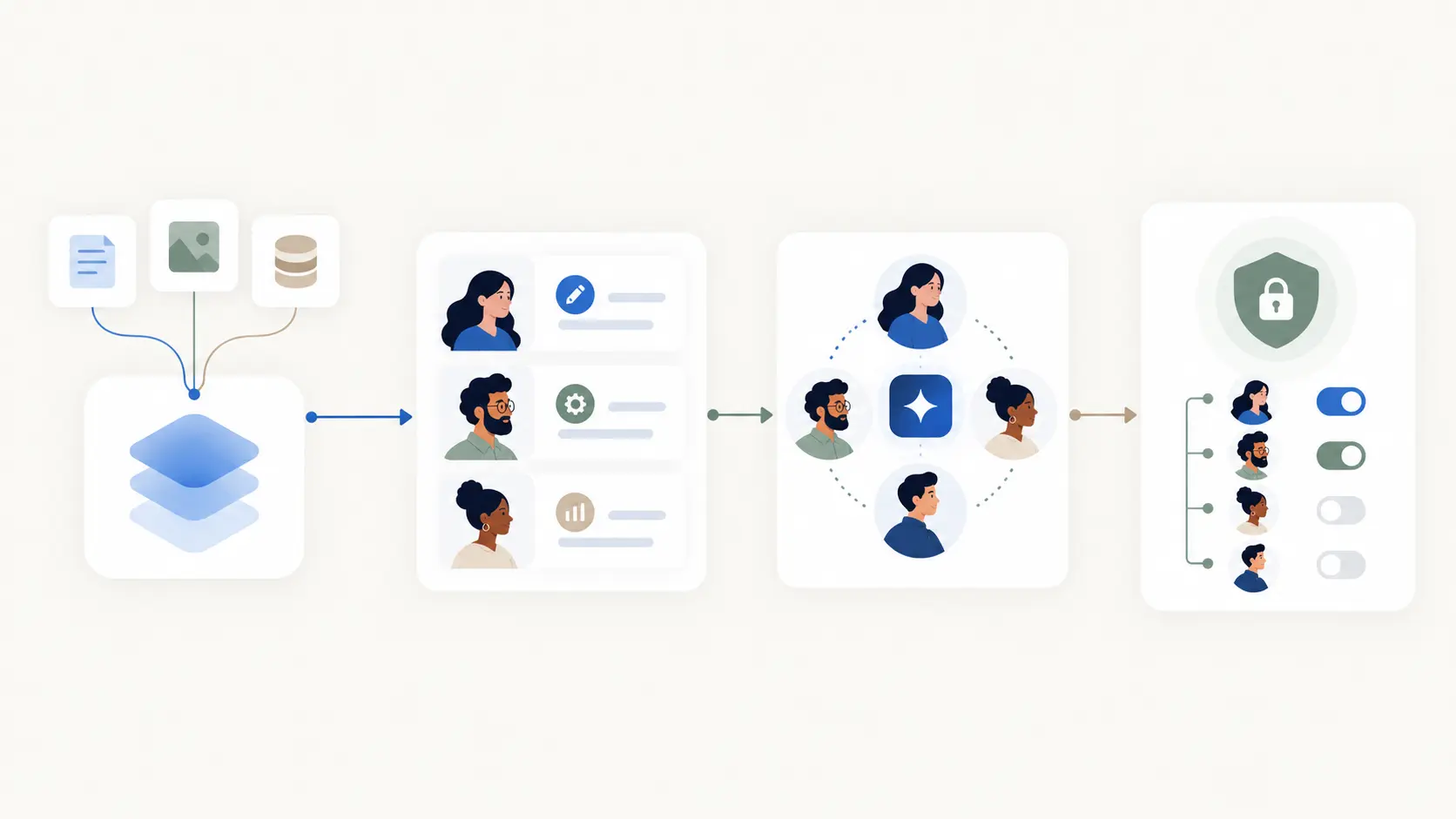
The usual rollout is a licence each and some enthusiasm.
Three months later, two people use it constantly, two have forgotten their password, and the business knows nothing it did not know before. The context all of it needed still lives where it always did, which is in people.
The order that works is almost the opposite. Establish what the business knows before you give anyone a tool. Decide who should see what. Then pick one piece of work that crosses people, and only then hand out access.
It takes longer to start and it is the difference between a team that uses AI and a business that runs better.
A deeper walkthrough
Why the licence-each approach disappoints
Nothing is wrong with the tools. The problem is that each one starts from nothing.
A person using AI privately has to supply all the context themselves, every time. They get good at it, which is the trap: the better they get, the more the value is locked in their head and their chat history.
So a year in you have some people who are noticeably faster and a business that is exactly as dependent on individuals as it was. If the person who got good leaves, so does most of it.
The shared version of the problem is worse. Five people asking the same model about the same client, separately, will get five slightly different answers, all confident.
What the business needs to know before anyone gets a tool
Four things. None of them require software to write down.
Who the people are. Clients, suppliers, who owns which relationship, which ones are delicate.
What is in flight. Active work, what each piece is for, what it is waiting on.
What has been decided, and roughly why. The reasoning is what stops the same argument happening twice.
How things are done here. The handful of standards you would tell a new starter in their first week.
That last one is the highest-value and the one most small businesses have never written down, because everyone already knows it. Everyone currently there, anyway.
Roles before permissions
In a one-person business this question does not exist. With three people it is immediate and it is easier to answer before anything is connected.
Who should see client commercial terms. Who should see anything financial. Who should see the whole picture versus their part of it.
These are not new questions. Every business answers them implicitly. Writing them down is mostly a matter of admitting what the answers already are.
The reason to do it first is that retrofitting boundaries is much harder than setting them. Once everyone has seen everything for six months, narrowing it feels like an accusation.
Pick work that crosses people
For the first real use, choose something that moves between at least two people.
A one-person task improved by AI is a private gain. Work that crosses a handoff is where the friction actually is, and improving it is visible to more than one person, which matters for whether anyone keeps using it.
Client onboarding is usually a good candidate. So is anything that goes from someone doing the work to someone reviewing it, and anything where a client-facing person needs history they were not part of.
Access last
Connect systems once the context exists rather than before.
An inbox connected to something that does not know who anyone is produces text. The same inbox connected to something that knows your clients, your projects, and what was agreed produces something useful.
Most teams do this the other way round because connecting is the easy part, then conclude AI is overrated when it turns out to be a fast way of generating plausible material about a business it does not know.
Give each thing an owner
Anything running without an owner will quietly stop.
That applies to a weekly report, a follow-up process, an onboarding sequence. Someone should notice if it did not happen, and in a small business that means naming them, because there is no system that will do it for you.
Same for the context itself. If nobody owns keeping the client list current, it will be accurate for four months and misleading after that, which is worse than not having it.
What good looks like six months in
Worth aiming at explicitly, because the usual measure of success is adoption and adoption is not the point.
Nobody talks about the AI much. It is in how work moves. Handoffs happen without a meeting. New people ask fewer questions that someone has answered before. The person everyone used to ask gets asked less, and is neither offended nor indispensable.
And when someone is off for a week, it is uneventful.
That last one is the real test. A small business that runs fine when a key person is away has stopped being fragile, and that is worth more than any amount of individual speed.
Why rollouts stall
Almost every team rollout that fizzles has the same root, which is treating it as something you finish.
A project has a launch and an end. You do the work, you go live, you move on. That framing produces four predictable outcomes, and you can usually recognise a rollout in trouble by which one it has hit.
Somebody gets handed it, normally the most technically comfortable person, and it becomes their project on top of their actual job. That holds while they have room. The week they get busy it stops, and nobody else knows enough to pick it up.
Or use gets mandated, because a project needs adoption numbers. People then use it for things it does not help with, conclude it is not much good, and are not wrong about the particular thing they tried.
Or the old way keeps running alongside, because nobody wants to switch off something that works. Now the team maintains two processes, and the new one never gets enough use to become the real one.
Or the decision about what stays human never gets made, because it was not on the plan. So it gets made by drift, one small expansion at a time, and you find out where the line should have been when something goes out that should not have.
The correction is a different frame rather than more effort. This is a change to how work moves between people, which means it wants a permanent owner rather than a project lead, the old way genuinely switched off, and the decisions revisited every few months as things earn more trust.
Why we built EverydayOS this way
The reason we build around the business rather than the seat is the licence-each problem.
Private AI use makes individuals faster and leaves the business exactly as dependent on individuals as before. The value only compounds when what one person establishes is available to the next, and when work handed to a colleague or to an agent carries its history with it.
EverydayOS is built so context belongs to the business rather than to whoever happened to type it, so roles decide what each person sees, and so a handoff does not require a conversation.
What that is for is a business that gets less fragile as it grows rather than more. Most small businesses get more fragile with every person, because every person adds things only they know.
Put AI to work around what matters most
Join early access to EverydayOS and help shape an AI operating system that can coordinate the essential things across your work and everyday life, without making you manage another pile of disconnected AI tools.
Join Early Access