The complete guide to AI for small business: what to use, what to automate, and how to get real value
Why everyone can be busy and the work still moves slowly
David Daniel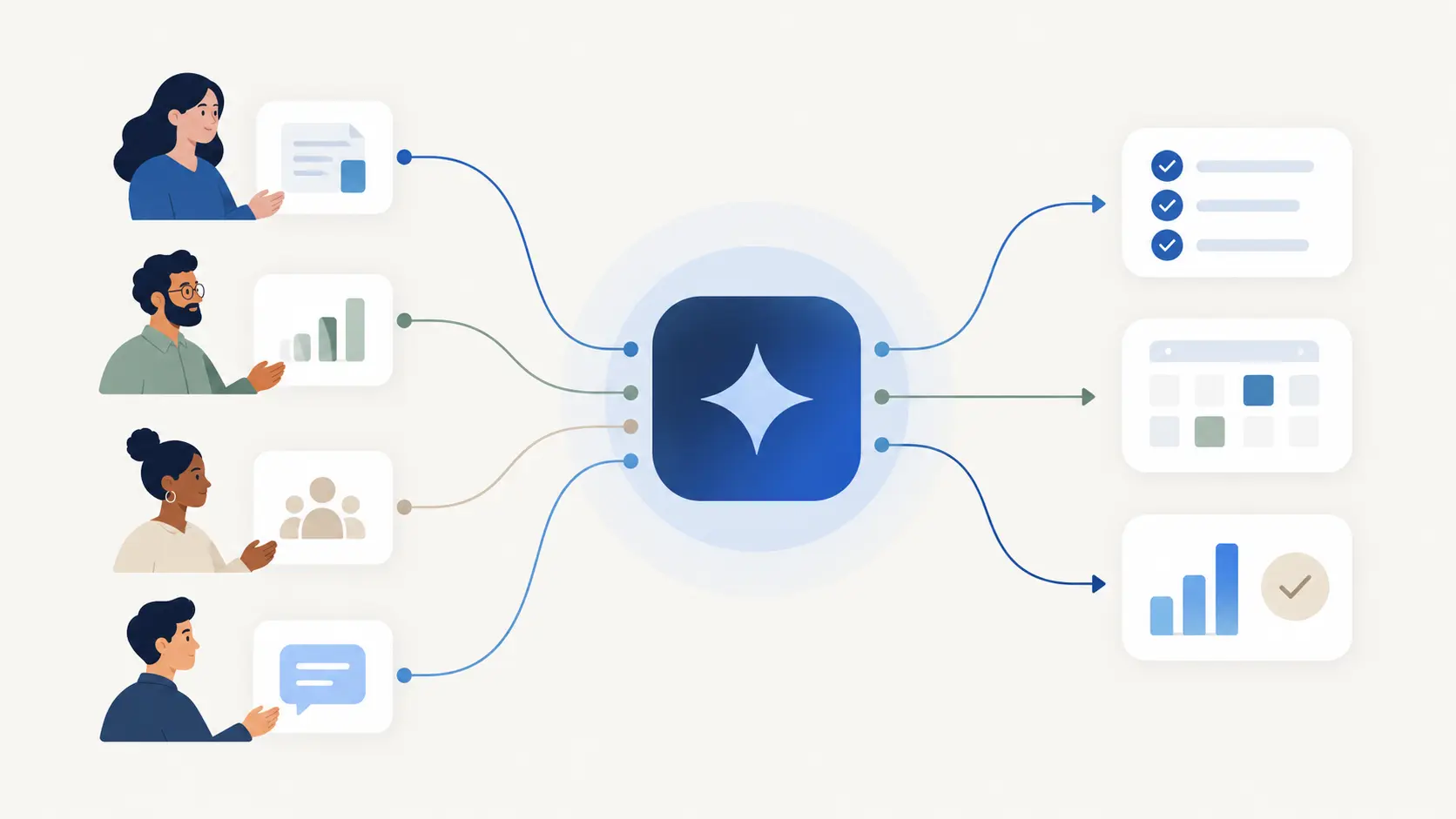
Think about a week where everyone was flat out and by Friday not much had actually moved.
Nobody was slacking. The work was moving between people, and every one of those moves cost something: a question that had to be asked, a piece of context that had to be re-explained, a decision that waited two days because the person who could make it was in something else.
That is the real constraint in most small businesses. Not effort, and not talent. The friction between people who each hold a different part of the picture.
Which is the thing worth aiming AI at, and it is not where most small businesses point it first.
A deeper walkthrough
The week where everyone is busy and nothing moves
A five-person business does not have a productivity problem in the way a large one does. Everyone is visible. Nobody is hiding.
What it has is a coordination problem that nobody owns, because in a business this size coordination is not anybody's job. It is a thing all five people do a bit of, in between the work they were actually hired for.
So the client question waits for the one person who knows the history. The proposal sits because the person who needs to approve it has not seen it. The new starter asks the same question three people have already answered, because the answer lives in a conversation from March.
None of that shows up as anyone underperforming. It shows up as everything taking slightly longer than it should, which is much harder to see and much harder to fix.
What actually slows a small business down
Four things, all of them in the spaces between people.
Context that lives in heads. The reason this client gets special treatment. The supplier you stopped using and why. Written down nowhere, known by two people.
Handoffs. Every time work moves, someone has to explain where it is. In a business of five that happens dozens of times a week.
Waiting for the person who knows. Not because they are slow, but because they are one person and there is a queue.
Answering the same question. The onboarding question. The process question. The where-do-I-find question. Answered individually, forever.
Add those up and they are usually larger than any individual inefficiency in the actual work. They are also the part nobody has time to fix, because fixing them is not billable and nothing is technically broken.
What it looks like when this works
Worth picturing, because it is more ordinary than the pitch and more valuable.
Someone picks up a client conversation they were not part of, and the history is there. Not a transcript. The useful version: what was agreed, what is outstanding, what to be careful about.
The new person is productive in their second week rather than their sixth, because the answers to the ordinary questions are somewhere other than in a colleague's memory.
Work moves between people without a meeting to hand it over. Things that used to wait for one person's attention now wait a lot less, because the context needed to move them is available to more than one person.
And you, as the owner, stop being the router. That is the one people feel most. A surprising amount of a small business owner's week is being the person who knows who to ask.
Where AI genuinely helps
Three places.
Holding what everyone needs to know. Client history, decisions, what was agreed, how things are done here. The thing that turns a handoff from a conversation into a glance.
Preparing work so the expensive person starts further along. Draft proposals, first-pass research, meeting preparation, summaries of long threads. Whoever is best at the judgment spends their time on the judgment.
Handling the recurring questions and the recurring admin. Onboarding answers, standard replies, the weekly report, the chase.
What is missing from that list: replacing anyone. In a business of five, everyone is already doing work that needs them. The gain is in the space between them.
The person everyone asks
Every small business has one. Sometimes it is the owner, often it is an office manager or a long-serving employee.
They know which client is sensitive, where the template is, what happened last time, who to call. None of it is in their job description. You discover how much of it there was the week they are on holiday.
That person is not a filing system. They are a filing system with judgment, which is why nobody has ever successfully replaced them with a shared drive. The drive holds documents. It does not know that this client always escalates to the founder, or that the last time you discounted for someone, it set a precedent you regretted.
What a small business actually needs is for that knowledge to exist somewhere other than in one person's head, without losing the judgment that makes it useful. That is a reasonable description of what AI can now do, and it is a different ambition from making everyone faster.
It is also worth saying plainly: the goal is not to replace that person. It is to stop the business being fragile because of how much only they know.
Why buying tools per person makes it worse
The instinct is to give everyone AI. A seat each, and off you go.
What happens is that five people each build a private relationship with a tool that knows nothing about the business. Five sets of prompts. Five accumulated conversation histories nobody else can see. Five people each explaining the same client to the same model, separately.
That is more AI and no more shared understanding. In some ways it is worse, because now the context exists in five private places rather than two heads, and none of it survives someone leaving.
The question to ask about any AI purchase for a team: does this make what one person knows available to the others, or does it give each of them a better private tool? Both can be worth buying. Only one of them addresses what is actually slowing you down.
What changes when it is not just you
Two things that do not come up in a one-person business and become important immediately with three.
Not everyone should see everything. Your bookkeeper sees the invoices. Not everyone sees salaries. A client-facing person needs that client's history, not every client's commercial terms. That is normal in any business and it means a shared system needs the concept of a role rather than one shared login.
Someone has to own each thing. Shared systems degrade when everything is everyone's responsibility. The same applies to whatever AI is doing: if nobody owns the fact that the weekly report goes out, it will quietly stop and nobody will notice for a month.
Both of those are ordinary management questions rather than technical ones. They get skipped because the software made it easy to skip them.
What leaves when someone leaves
Every small business has been through a version of this. Someone goes, and over the following weeks you find out what was in their head. Which supplier to call. Why that client gets handled carefully. Where the thing is.
There is now a second version of it, and most businesses have not noticed it forming.
If your people use AI privately, the understanding they built goes with them. The prompts they refined. The conversation history that knows your clients. The way of working they worked out over a year. None of that is in a folder anyone can open. It was never yours.
That is the ownership question, and it is worth settling before it matters rather than during a notice period.
What should belong to the business. Client history, decisions and why they were made, how things are done here, what was agreed with whom. That is operating knowledge. It was produced on your time, about your business, and it should still be there on Monday.
What should belong to the person. Their drafts, their working notes, the half-formed thinking they have not shown anyone. People need somewhere to be uncertain. A business that hoovers up every keystroke gets worse work, because nobody will risk a rough version.
What should be decided rather than assumed. Who sees what, by role. What happens to someone's access on their last day. Whether a departing person can take a copy of anything, and of what.
None of those are exotic questions. Every business already answers them for email and files, usually because it was forced to at some point. AI has quietly created a new category of the same thing, and most small businesses have no position on it at all.
The test worth applying: if your best person resigned on Friday, what would the business still know on Monday? If the honest answer is "less than it should," the problem is not loyalty. It is that the understanding was never anywhere the business could reach.
Where the bar should be higher
There is no permanent list of things a business must keep human, and the principle that holds up is about consequence: the harder something is to undo, the more it costs when wrong, and the more judgment it takes, the higher the bar before it happens without a person.
For a small business a few things sit high on that bar. Anything that speaks to a client in your name, because you do not have a brand big enough to absorb a bad one. Pricing and negotiation. Anything that commits money. And hiring, which is the decision most likely to be dressed up as a process and is not.
All of those can move over time, with explicit authority and a way to check what happened. What should not move is the threshold.
The money question
Small businesses tend to evaluate AI as a subscription, which produces the wrong decision in both directions.
Counted honestly, the costs are the licences, the hours of setup, the ongoing checking, and the tools nobody ended up using. That last one is usually the biggest and never appears in anyone's calculation.
There is also a cost most businesses are carrying without seeing it, which is paying more than once for the same capability. Five seats of a writing tool, a CRM with AI built in, a meeting recorder that summarises, and a project tool that drafts updates. Four line items, substantially overlapping, none of which knows what the others know. You are buying the same thing repeatedly and getting a fragment each time.
So the question worth asking of anything new is not only what it costs. It is what you would stop paying for if it worked.
On the other side, the thing worth measuring is not hours saved, because saved hours in a small business tend to get absorbed into other work and disappear. Measure whether work moves faster between people, whether things stop waiting on one person, and whether a new starter becomes useful sooner.
And the version of the return that matters most is one you notice in retrospect: you took on more work without the operational side getting heavier.
Why the obvious moves are usually the wrong ones
There is a pattern in how small businesses get this wrong, and seeing it explains most of the individual mistakes.
Every common misstep picks the visible thing over the binding one.
Buying a seat for everyone is visible. You can point at it, it feels fair, and it is something you have actually done. Whether work moves any faster between people is not visible, and that was the thing slowing you down.
Starting with marketing is visible. The output is right there, you can show it to someone, and it feels like progress. But the reason a proposal took three weeks was almost never the copy. It was that it sat with two people for four days each.
Measuring adoption is visible. You can count who logged in. Whether anything is better is harder to see, so people count what they can count, and then wonder why usage looks healthy and the business feels the same.
The quieter failures work the same way. AI becomes one person's project because that person is keen and progress is obvious while they are on it, which holds until the week they get busy. And processes get automated before anyone has defined them, because defining a process is slow and nobody can see you doing it, while automating one is something you can demonstrate on a Friday.
The correction is dull and it works. Before adding anything, say out loud what the constraint actually is. Then ask whether the thing you are about to do touches it. If the honest answer is that it touches something adjacent and easier to show people, you already know.
Why we built EverydayOS this way
We build for the business rather than for the seat, because of the five-private-tools problem.
A team of five with five private AI tools has five fragments of the business and no shared picture. What we think a small business actually needs is one place where the context lives, with different people seeing the parts appropriate to their role, and humans and AI working from the same version of what is true.
EverydayOS is built so what one person establishes is available to everyone entitled to see it, so work handed between people or to an agent carries its history with it, and so authority is something you grant by role rather than a single switch.
What that gives a small business is the thing an experienced operations hire gives, arriving earlier than you could afford one. Not more output. Less depending on who happens to be in.
Where to start
- Write down what only one person knows. That list is the risk and the opportunity.
- Follow one piece of work across three people. Count the explanations.
- Start with the handoff, not the task. Where work waits is where the value is.
- Put context in one place before you buy seats.
- Give each thing an owner. Including the AI-run ones.
- Set roles before permissions. Who should see what, decided once.
What actually changes
Check in a quarter, and check the right things.
Not how much everyone is using it. Whether the business got less fragile.
That shows up in ordinary ways. Someone was away for a week and it was uneventful. A new person got useful faster than the last one did. A client conversation got picked up by whoever was free rather than by whoever knew. You went a whole week without being asked a question only you could answer.
None of it feels dramatic. It feels like the business running slightly more like an organisation and slightly less like a group of people who all know different things.
Put AI to work around what matters most
Join early access to EverydayOS and help shape an AI operating system that can coordinate the essential things across your work and everyday life, without making you manage another pile of disconnected AI tools.
Join Early Access