
How to work out which parts of your business AI should take
List everything your business has to do, then decide what happens to each one
David Daniel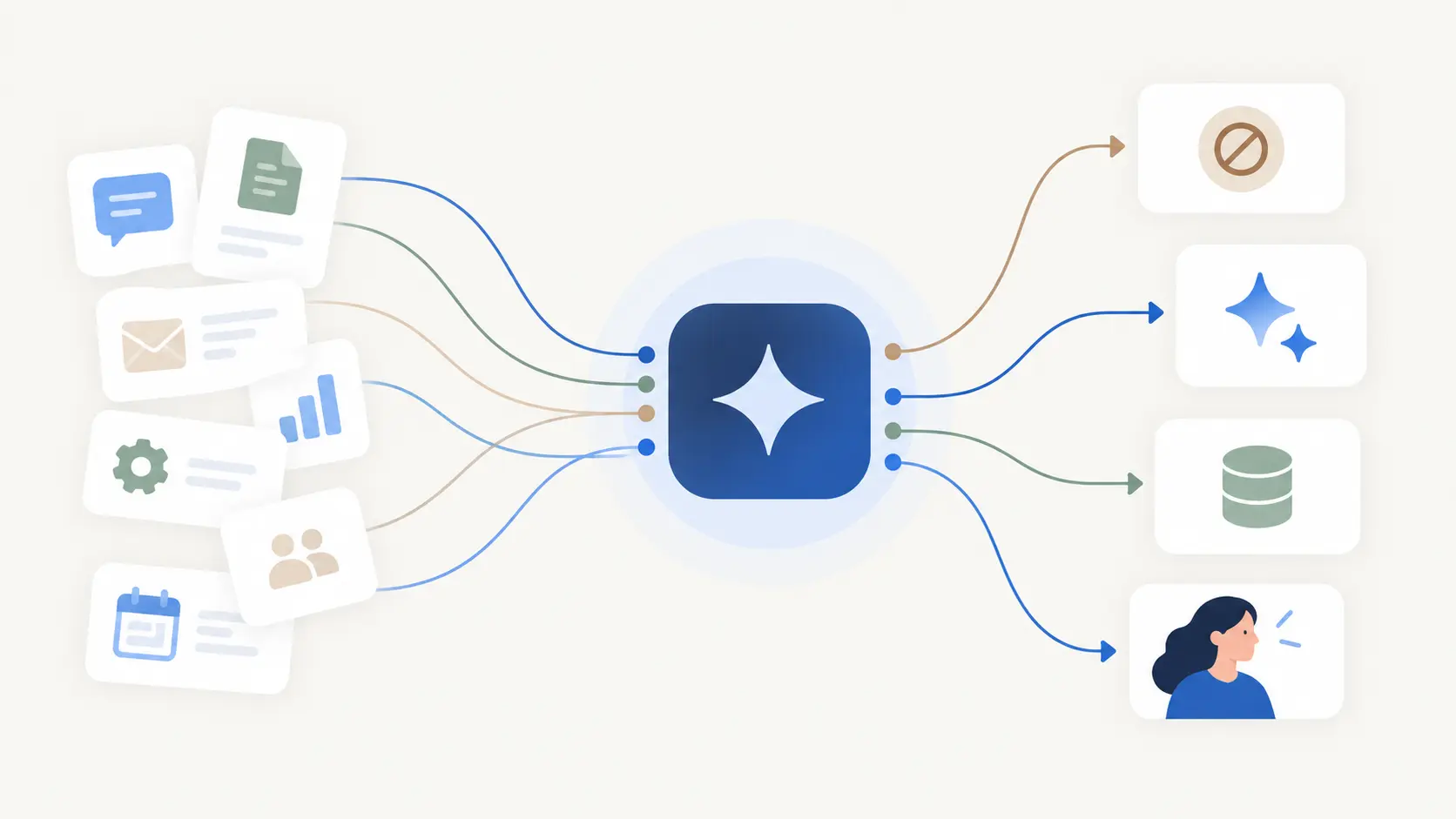
Most AI adoption starts with a task somebody noticed. That produces improvements and leaves the business shaped exactly as it was.
The exercise that changes things is duller and works better. Write down every function your business actually needs performed for it to operate. All of them, including the ones nobody would call a job.
Then make one decision about each. Most will fall into six outcomes: stop doing it, simplify it, give it to a system, give it to an agent, give it to a person, or keep it yourself.
Two things usually come out of this that nobody expects. A number of functions turn out not to need doing at all. And some of what you were about to automate should be eliminated instead, which is cheaper and better.
A deeper walkthrough
Nobody has written this down
Ask an owner what their business does and you get what it sells. Ask what has to happen for that to keep working and the answer takes longer, because it has never been written down anywhere.
Invoicing. Chasing. Onboarding. Answering the ordinary questions. Keeping the website current. Deciding what to charge. Noticing when a client goes quiet. Filing things so they can be found. Making sure the person who needs to know, knows.
Some of those have an owner. Many are done by whoever notices, which usually means whoever notices is you.
That list is the business. Not the org chart, which describes the people you happen to have. The list of functions describes what has to occur, which is a different and more useful thing.
Why functions rather than tasks
A task is a thing you do. A function is a thing the business needs, whether or not anyone is currently doing it.
The difference matters because task lists inherit the current setup. If you have always done onboarding in a particular way, the task list describes that way, and improving it means making that way faster.
A function list asks what actually has to be true. New clients need to know what happens next, have what they need to start, and feel looked after in the first fortnight. That is the function. How it happens is up for grabs.
Starting from functions is what lets you notice that three of your current steps exist because of a tool you stopped using two years ago.
The six outcomes
Once you have the list, each item gets exactly one decision.
Stop. It made sense once. It does not now, and nobody would notice. The most satisfying outcome and the most frequently skipped, because stopping something feels like admitting it was wasted effort.
Simplify. It has to happen, and not in this form. Four approvals where one would do. A report nobody reads that could be three lines.
Give it to a system. Predictable, defined, same every time. This is ordinary automation and it is where the least interesting functions should go.
Give it to an agent. Recurring, needs some judgment, no fixed script, and being wrong is recoverable. Chasing, monitoring, preparing, first-pass research.
Give it to a person. Needs judgment, relationship, or accountability. The work you would hire for.
Keep it. The things that are genuinely yours: direction, the relationships that matter, the final call on anything hard to undo.
Order matters. Run stop and simplify first, because automating something you should have eliminated is the most common expensive mistake in this whole exercise.
What it looks like when this is done
Worth describing, because the output is not a document.
You know what your business actually does, in about forty lines. Every one of those lines has a decision attached and something or someone responsible for it.
The things that used to happen because you noticed them now happen because something is watching. The things nobody was doing are either being done or have been explicitly dropped, which is better than sitting in the gap where they get remembered at the worst moment.
And you can see, for the first time, where your own week goes. Most owners doing this discover they are personally holding eight or nine functions that have nothing to do with why they started the business.
The relief is not that everything got automated. It is that nothing is unaccounted for.
How to actually run it
It takes an afternoon and it is worth blocking one.
- Brain-dump the functions. Forty-five minutes, no sorting, no judging. Go through a normal month rather than working from a template.
- Add the invisible ones. The things that happen because someone notices. Ask what would break if you were away for a fortnight.
- Mark who does each one now. Including "nobody" and "whoever spots it", which are the interesting answers.
- Do the stop pass. Straight through the list, only asking what would actually happen if this stopped.
- Do the simplify pass. What is left, at half the steps.
- Sort the remainder into the four homes. System, agent, person, you.
- Name an owner for every line. Including the automated ones, because something with no owner will stop and nobody will notice.
The ones that surprise people
Three patterns come up almost every time.
The function nobody owns. Something important that happens only when someone happens to notice. Usually the source of the incidents you cannot explain.
The function you kept because you are good at it. You are quick at it, so you kept it. Being good at something is not a reason for it to be your job.
The function that only exists because of a tool. Steps whose entire purpose is feeding a system you chose years ago. If the tool went, so would the work.
What this tells you about hiring
The useful side effect is that you find out what a hire would actually be for.
Most small businesses hire against a feeling of being overwhelmed, which produces a vague role and a person who ends up absorbing whatever is loudest. A function list produces a job description made of things the business genuinely needs, and it shows you whether the answer is a person at all.
Sometimes the honest conclusion is that you have two functions needing judgment and eleven needing consistency. That is not a hire. Sometimes it is the reverse, and no amount of AI will fix it.
Doing it again
A function list is accurate for about six months.
Work changes, the business changes, and decisions made against last year's picture get quietly wrong rather than obviously broken. Twice a year is enough, and the second time takes an hour rather than an afternoon.
The question on the repeat is different. Not what should happen to each function, but whether the decision you made is still right. Things earn more trust. Some things turn out to need a person after all.
Why we built EverydayOS this way
An exercise like this produces a picture of your business, and in most cases the picture then lives in a spreadsheet nobody opens again.
The reason we build the way we do is that the picture should be the thing the system runs on. Who your people are, what the functions are, who owns each one, what may happen without asking, and whether it actually happened.
EverydayOS is built so that structure is operational rather than documentary. A function assigned to an agent, a person, or an automation looks the same from where you sit, and you can move it when the answer changes without rebuilding anything.
What that is for is a business where nothing is unaccounted for, and where the answer to "who does that" is never "whoever notices."
Put AI to work around what matters most
Join early access to EverydayOS and help shape an AI operating system that can coordinate the essential things across your work and everyday life, without making you manage another pile of disconnected AI tools.
Join Early Access